

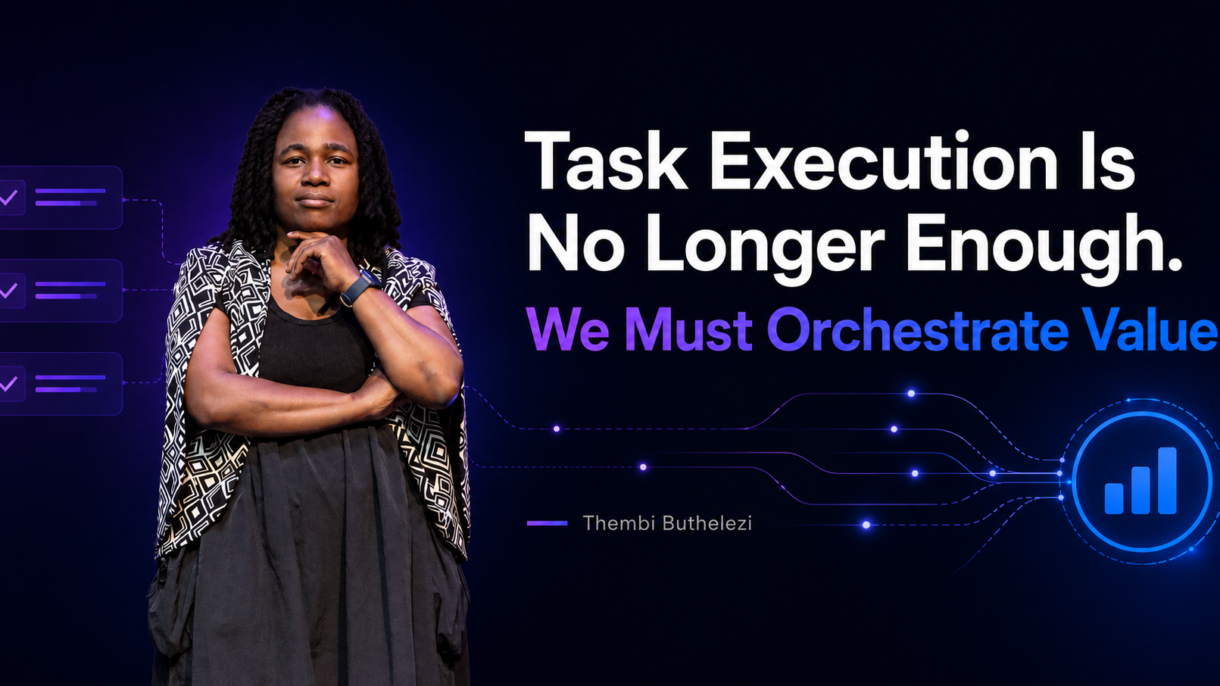

I have been having tough conversations with my dev team about the difference between executing tasks and orchestrating value to achieve the end result.
A lot of us get stuck in saying, “But I have done the task. I have done what I was asked to do. I have done my piece excellently.” But without the seeing and fulfilling of the end-to-end value, the task in and of itself can become meaningless.
That is where the conversation becomes uncomfortable.
Because many of us have been trained to measure ourselves by task completion. “I completed the ticket.” “I sent the thing.” “I built the feature.” And all of that may be true. But if the business, the client, the user, or the stakeholder does not experience the value that was meant to come from that work, then the completed task starts losing meaning.
This is not only a development team issue. I see it in business all the time.
A client will say, “I need a website.” But when I go deeper, the real question is not the website. The real question is: what must the website achieve? Is it meant to create credibility? Generate leads? Explain the business better? Help the founder look more serious in front of funders or clients?
Another client will say, “I need an app.” But again, the app is not the point. The question is: what problem must this app solve? What behaviour must it change? What process must it improve? What value must it unlock?
Even in my events business, a client may ask for screens, sound, staging or lighting. But my job is not only to supply equipment. My job is to understand the production they are trying to create. What must the audience feel? What must the brand communicate? What experience must the event deliver?
That is the difference between delivering to the brief and delivering value.
You can deliver exactly what was requested and still miss the point.
You can complete the task and still fail the outcome.
And in the age of AI, this distinction is becoming even more important. AI can execute many tasks. It can generate code. It can generate documents. It can generate content. It can generate ideas. It can help produce strategy. The tool is becoming available to everybody.
So if your value is only in task execution, you are opening yourself up to being replaced by machines. Because machines can execute tasks. They can generate. They can produce. They can follow instructions. The question then becomes: what is your value add in the equation?
The real value is in seeing the bigger picture. It is in asking better questions. It is in understanding what the work is meant to achieve. It is in connecting the moving parts. It is in knowing when to challenge the brief because the brief may not actually deliver the result the client or business needs.
That is the skill I continue to sharpen in myself, my teams and my businesses.
Do not just ask, “What must I do?”
Ask, “What value must this create?”
Because task execution may get the work done, but the orchestration of value is what makes the work meaningful.